
题目:
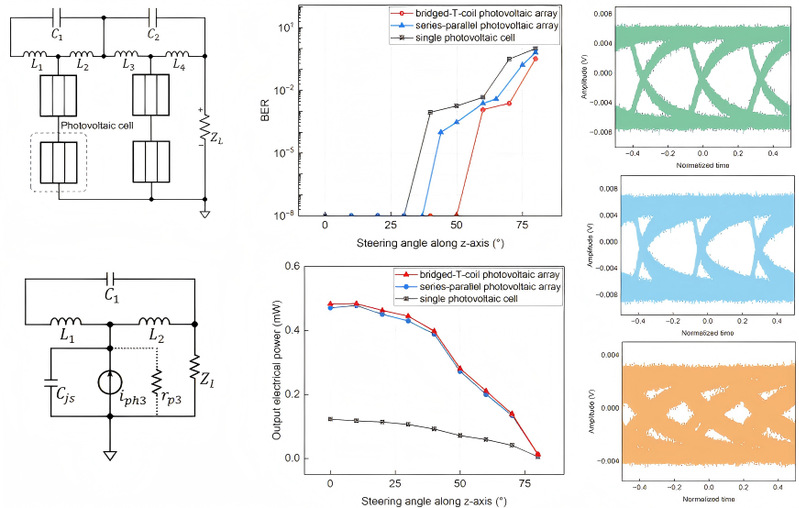
Design and implementation of photovoltaic array for integration of visible light communication and wireless power transfer systems
作者:
Huilin Ni1, Jizhou Zhuang1, Lipeng Qiu1, Xiaofeng Li1, Dong Ma2,*, and Shaolong Wu1,3,*
单位:
1 School of Optoelectronic Science and Engineering & Key Laboratory of Advanced Optical Manufacturing Technologies of Jiangsu Province & Jiangsu Key Laboratory of Flexible Optoelectronics and Micro-Nano Manufacturing, Soochow University, Suzhou 215006, China
2 School of Rail Transportation, Soochow University, Suzhou 215137, China
3 Zhejiang Key Laboratory of Information and Energy Integrated Microsystem, Yangtze Delta Region Institute (Huzhou) University of Electronic Science and Technology of China, Huzhou 313001, China
Abstract:
The integration of visible light communication (VLC) and wireless power transfer (WPT) offers a sustainable platform for powering Internet of Things (IoT) devices while enabling simultaneous data transmission. However, conventional receivers based on a single photovoltaic (PV) cell are constrained by the inherent trade-off between bandwidth and output power. To overcome this limitation, this paper proposes a PV array-based solution and designs its circuit topology, achieving both high output power and extended bandwidth. An equivalent circuit model of the PV array is established to facilitate theoretical analysis, and the transfer function is derived to evaluate system performance. Furthermore, the influences of different array configurations and peripheral circuits are investigated, leading to the adoption of an optimized bridged-T-coil structure. Numerical simulations and comparative experiments on 4-cell array configuration demonstrate that the proposed bridged-T-coil topology achieves a 3.13× bandwidth enhancement and nearly quadrupled output power com-pared to a single PV cell. Furthermore, when evaluated against the average bandwidth-power product of the five other internally developed array architectures for a fair comparison, the bridged-T-coil array yields a value of 93.81, exceeding their mean performance by approximately 20.7% on average. To the best of our knowledge, this work presents the first systematic design and investigation into the circuit topology and performance of a PV array receiver for VLC-WPT systems, and provides a practical receiver solution for low-power IoT nodes requiring integrated energy and communication capabilities.
可见光通信与无线能量传输的融合为物联网设备的供电与同步数据传输提供了一个可持续的平台。然而,基于单个光伏电池的传统接收机受限于带宽与输出电功率之间的固有折衷。为克服这一限制,本文提出一种基于光伏阵列的解决方案并设计其电路拓扑,在实现高输出电功率的同时扩展其工作带宽。首先,建立了光伏阵列的等效电路模型以进行理论分析,并推导了传递函数以评估系统性能。其次,对比研究了不同阵列配置及外围电路的影响,进而证明了所提出的桥式T型电路拓扑结构的优势。以4个光伏电池构筑的阵列为例进行的数值仿真与对比实验表明,与单个光伏电池相比,所提出的桥式T型电路拓扑同时实现了3.13倍的带宽扩展和近4倍的输出电功率。此外,与其他五种阵列结构的平均带宽-功率乘积相比,桥式T型电路拓扑的该项指标达到93.81,明显高于所有对比案例。本文首次对面向可见光通信-无线能量传输系统的光伏阵列接收机电路拓扑及性能进行了系统设计与研究,为亟需集成能量与通信能力的低功耗物联网节点提供了一种兼具理论参考与实用价值的接收机方案。
影响因子:17.2
分区情况:一区(通信领域顶刊)
链接:https://ieeexplore.ieee.org/document/11547168